Noh actor and playwright
Zeami
世阿弥 · c. 1363–c. 1443 · Muromachi period
Zeami (世阿弥) was the actor and playwright who made noh theatre what it is today. Many of the plays he wrote are still performed six hundred years later. He also wrote secret books on the art of acting. His ideas about beauty still shape Japanese arts.
The boy the shogun noticed
Zeami was the son of Kan'ami, the leader of a popular troupe of performers. In 1374 or 1375 the troupe played before the young shogun Ashikaga Yoshimitsu. Zeami was about twelve. The shogun was charmed and became the troupe's patron. Zeami grew up close to the court, among poets and nobles, and learned the refined taste of the elite. He turned his father's lively shows into a slow, elegant art. Its ideal was yūgen, a deep and mysterious beauty that you feel more than see. Many of his plays are "dream plays." A traveller meets a stranger, who turns out to be a ghost. The ghost relives the moment that still binds it to this world.
The flower of the actor
Zeami wrote down his teaching in a series of treatises. The best known is Fūshikaden, from around 1400. In it he calls an actor's power to move the audience the "flower." Like a real flower, it must feel fresh every time. He also wrote: "What is hidden is the flower." Another line from his writings is still a common saying in Japan: shoshin wasuru bekarazu, "never forget the beginner's mind." His last years were hard. A later shogun turned against him. In 1434, at over seventy, Zeami was exiled to the island of Sado. Nobody knows exactly when he died.
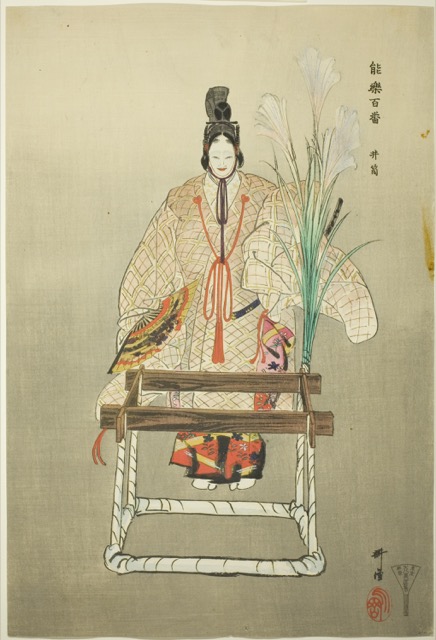
Print of his play Izutsu (no portrait of Zeami survives): Tsukioka Kōgyo · Public domain · via Wikimedia Commons
.jpg)